If we have no peace, it is because we have forgotten that we belong to each other.
– Saint Mother Teresa
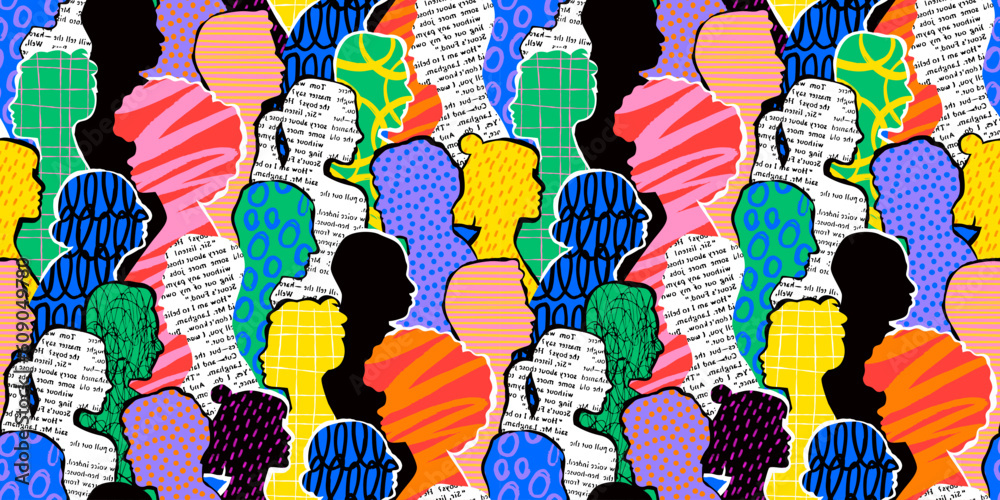
In my blue jeans and cotton t-shirt, I stroll on the spacious Eastern Prom in Portland, or cozy-up in small cafes. I scan the city’s humanity, all sizes, ages, energies, ethnicities and skin tones. Some of us wait in line here, frolic with families there, gather at picnic tables at the park or convene in coffee house corners with laptops and croissants. Diversity and difference fill this city.
My mind first notices all the not-the-same-as-me. An Asian woman, with straight black hair, on a bench near the ocean, shuffles her silk blouse over her breast as she nurses a baby, and sings a sweet high-toned lullaby in a language I don’t know. Two loud curly-haired teenagers argue in French without making eye contact, always checking their phones. A toddler plays with toys while the adults with him instruct him in Spanish. On the hill, four dark-skinned men kick a soccer ball. With many families, activities and groups, Portland holds stunning fullness.
In this sea of contrasts, with a not-like-me focus, we can feel distant from those with whom we share Portland’s peninsula. Then, inside such comparisons, if we distance ourselves, the inner judge often speaks. “That tall man, pushing others out of his way, is impatient. That young mother, scolding her son, is mean. Those children, fighting, should settle down. I don’t know those people.”
As soon as I hear my label, “those people”, I recognize our common pattern of “othering.” Diversity alone does not create othering; othering arises with judgment. With attention drilled down on differences, we can miss similarities.
My heart knows that us-and-them lies at the core of social struggles. When, or if, the criticizing mind rules, “not-like-me” can spread into there-is-no-way-I-will-understand-you. We look at the human beings in our surroundings, but we do not really see them, not their depth nor their wholeness.
Forty-five years ago, my friend Ralph gave me advice, after I said, “This child of mine loves school and studying; that one hates and refuses to do homework. This one wins coaches awards in team sports. That one gains leading roles in children’s plays and loves to perform alone on stage. This one hops into the shower every morning. That one insists on going to school in pajamas. My two children are so unlike, which makes parenting difficult.”
Ralph nodded, “Mmm. Parenting becomes easier if you focus on how they’re alike.”
So, I adopted finding alikeness. Simple, not easy.
“They both burst with boundless energy. They both laugh with a fun sense of humor. They both love their friends. They both beam passion for their after-school activities. They both dislike the bus and school lunches.” What’s-alike offered a larger view, more peace, as Mother Teresa said.
So, now, as I meander around Portland, I smile when I notice what I share with those I might have called strangers. “What’s alike,” mimics an ancient awareness training I learned years ago and sounds like this:
That tattooed-covered man yells at his children in Portuguese. Like him, I sometimes feel anger. Like me, this person has thoughts, emotions and difficult feelings.
That woman, in the floor-length floral dress and head scarf, cries as she writes in a notebook. Like her, I have moments of sadness. Like me, her heart can feel tender or hurt.
That older gentleman, with his bulging belly hanging over his belt, eats two donuts. Like him, I buy extras. Like me, he likes the taste of yummy treats.
The mom next to me hears me say to a friend on my phone, “yes, my daughter played soccer.” She drapes her arms around her young child, leans toward me, and says, “I hope someday my daughter will play soccer.” Like me, she wants her children to join, to have strong bodies and minds.
Life shows up with many backgrounds, actions, voices, languages, demeanors, postures, skin colors and dress. We, no doubt, have experienced vastly varied events, pasts, religions, social norms and cultural customs.
Yes. True. And what else is true?
We can receive the blessing of more inner peace if we come to know that we are different and we are the same:
Like me, that woman has known physical, emotional pain and suffering.
Like me, that man wants to feel safe.
Like me, the children want to be liked and loved.
Over time, a bigger “we” emerges. We all want to be happy. We all have moments of confusion. We all feel afraid at times. We all long for friendship. We all hope to be healthy.
Othering and us-and-them grow when centered on not-like-me. Yes-like-me grows, too, with learning, opening, curiosity and empathy. The way we long for happiness differs, for sure. The way we express our wants and needs differs widely, of course, as do our histories, our bodies, our cultures. But the perspective shift from separation to connection deepens us and highlights the fact of our universal humanity. What a gift.
To feel alikeness takes a conscious decision, and invites us into a sacred process. With lifelong practice, like-me-like-them, builds bridges, lets walls fall, and offers a unifying pathway to remember that, indeed, we belong to each other.


Thank you, Susan, for such a thoughtful article. I am going to print it to remind me to find the things that I share with others and not be so judgmental or see “differences”.
Thanks so much, Pat. I really appreciate your kind words,
Sue
Such a good message, Sue. I really love the idea of looking at how we are the same rather than pointing out our differences. We are all unique so there will always be differences. But we are all human beings with the same emtoions and needs. And you are absolutely right, we are one, who belong to each other.